
Technology
Anthropic Says It Will Revolutionize Biology—Some Day
By Marcus Chen
Advertisement · Why this ad?
Marcus manages the day-to-day editorial workflow across all brands, coordinating coverage assignments and ensuring editorial standards are met. He previously served as city editor at the Pioneer Press and holds a degree in Political Science from Carleton College.
More from Marcus →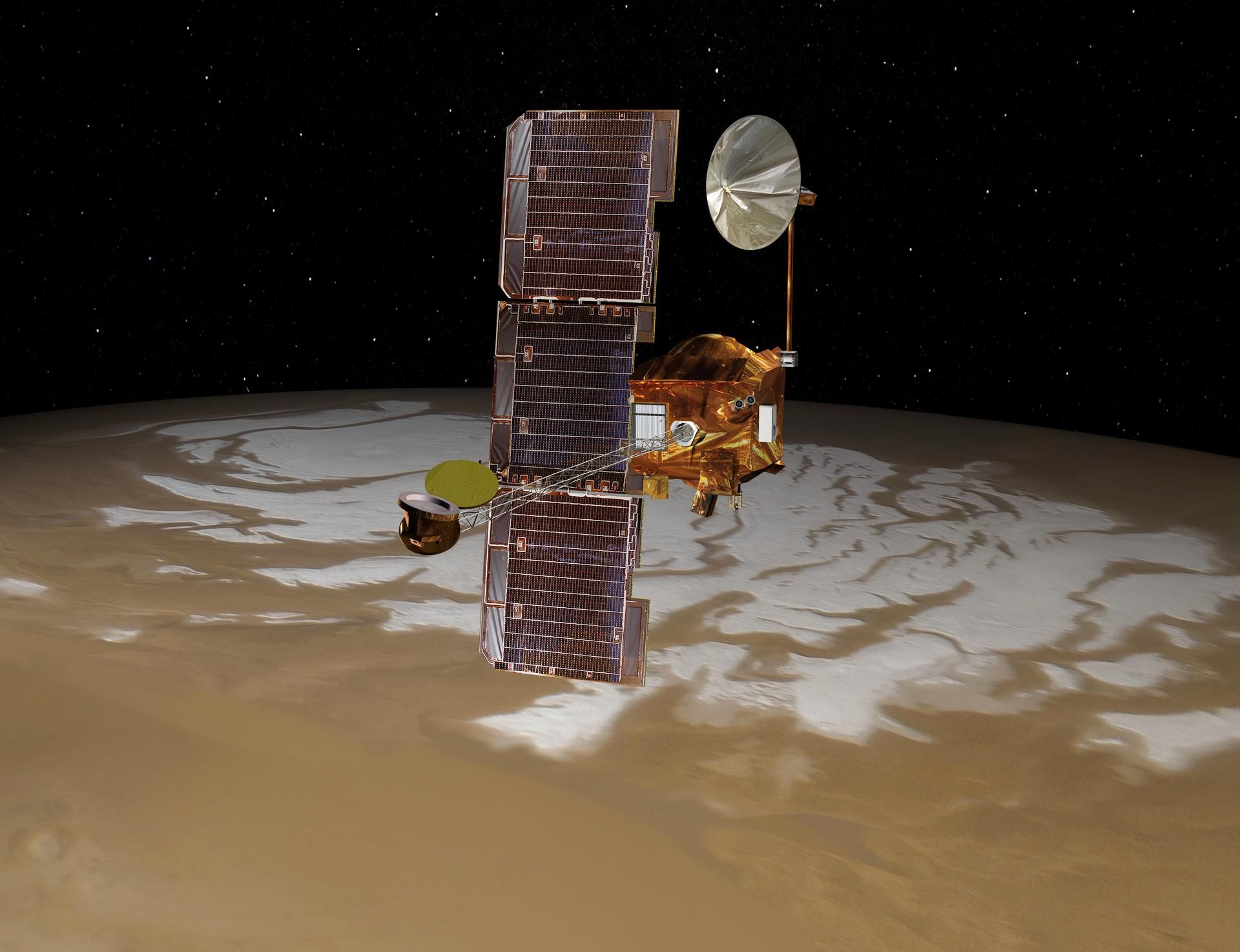
Meghan BartelsScienceOct 27, 2026 6:45 AMNASA’s Oldest Martian Spacecraft Have Been Running for Decades. Here’s HowTwo orbiters have long outlasted their expected lifespans and completely reshaped our understanding of the Red Planet, all while operating 140 million miles from Earth.Courtesy of NASA/JPLSave StorySave this storySave StorySave this storyNASA’s Mars Odyssey spacecraft has been operating for so long, it can rent a car without any fees. The spacecraft arrived at the Red Planet on October 24, 2001. It, along with its 20-year-old sibling, the Mars Reconnaissance Orbiter (MRO), have operated longer than anyone watching their launches could have dreamed possible.Having such a long record of observations from above the Martian surface has rewritten the story of water on the planet, past and present alike. Keeping the wizened orbiters going for so long has been possible only thanks to great engineering and constant problem solving—and a little luck. But scientists wonder whether, despite their storied legacies, Odyssey and MRO will be the last of their kind, at least for the Red Planet.“Both Odyssey and MRO are some of the most productive spacecraft that have ever existed,” says Briony Horgan, a planetary scientist at Purdue University who isn’t affiliated with either mission, calling them “critical” to NASA’s overall Mars research program. Odyssey’s observations of the planet’s ice, for example, and MRO’s ability to see surface features change over time have each given scientists unprecedented insight into Mars as a vibrant planet rather than a lump of rock. Odyssey and MRO also connect humans to every NASA rover, which can’t communicate with Earth directly. It’s an impressive legacy for a pair of orbiters that were only meant to last just a few years.Space is a notoriously harsh environment that takes luck and resilience to survive for decades. Particularly tricky is the barrage of high-energy particles hitting machinery; a powerful enough strike to a delicate enough apparatus can be fatal. And whereas engineers can keep constant tabs on satellites orbiting Earth, bandwidth to Mars is more limited—science spacecraft might only check in once or twice a week, says Rob Lillis, a planetary and space physicist at the University of California, Berkeley, who has worked on a range of more recent Mars orbiters.“A Mars craft has to be able to manage by itself,” he says.A concept image of the Mars Reconnaissance Orbiter. Courtesy of NASA/JPLLosing an instrument is bad, but losing the power or computing systems can brick the whole craft. NASA often doubles up on vital parts of a spacecraft to ensure that if something important fails, the mission can run off the spare until engineers can troubleshoot a problem.In the MRO’s case, one challenge it’s faced is ironically due to its staying power. The orbiter determines its precise location and orientation by comparing what its cameras see with a stellar atlas onboard—with just one hiccup. “MRO is actually old enough that some of those stars have moved across the night sky—very slightly, but they have moved,” says Paul Fieseler, an engineer at NASA’s Jet Propulsion Laboratory and chief engineer for MRO. The tiny misalignments confused the spacecraft, and last year, engineers had to send up an updated map to keep MRO oriented into the future.Odyssey’s greatest risk right now is simply running out of propellant it uses to make tiny adjustments to maintain its orientation in space. The spacecraft doesn’t have a fuel gauge–without gravity to push the fuel down, there’s no volume to measure–so NASA can’t be sure how much juice it still has. Engineers have improvised new ways to fully operate the spacecraft on just a few drops at a time in a bid to extend its life.Experts say both spacecraft benefited from failures during NASA’s infamous “faster, better, cheaper” era. In 1999, NASA lost two missions arriving at Mars: First the Mars Climate Orbiter burned up in the atmosphere, and then, just months later, the Mars Polar Lander botched its arrival and slammed into the surface. Each catastrophe, investigations determined, was caused by what might in more pedestrian realms be dubbed careless mistakes. The first was due to miscommunication between a ground system relying on imperial units and the flight system using metric, while the second was due to a software error not caught during testing.“Those failures were very much on the mind of the team pulling together the Odyssey spacecraft,” says Glen Havens, an engineer at JPL and project and mission manager of Mars Odyssey. With those losses stinging, NASA invested more in perfecting the Odyssey and MRO spacecraft before launch, designing each to be as resilient as possible and testing every tiny component and every system configuration.Topographic imagery from Mars captured by the MRO. Courtesy of NASA/JPLOne key principle is what NASA calls “margin”—the spacecraft equivalent of carrying a snack, just in case.“Unexpected things might happen, and you want to make sure the spacecraft will survive,” says Nilton Renno, a spaceflight engineer at the University of Michigan who hasn’t worked on either mission. MRO launched with a larger battery and more propellant than it strictly needed, Fieseler notes, and that margin is now keeping the mission going, with NASA hoping to operate it for another decade.But orbiting Mars, it’s wise not to take anything for granted. Just last year, NASA lost the 11-year-old Mars Atmosphere and Volatile Evolution—its youngest Red Planet orbiter—after the spacecraft unexpectedly lost power on the far side of the planet. As Odyssey and MRO continue to age, questions linger about what Mars orbiters come next for NASA.The agency has hired Blue Origin to build a dedicated communications satellite to beam scads of data back to Earth for at least five years—but unlike its forebears, which began as science missions before turning to communications work, this orbiter will only relay signals for
By Marcus Chen

By Katherine Langford

By Katherine Langford

By Katherine Langford